Click, Deliver, Pollute: The Dirty Secret Behind the Apps Running Your Life
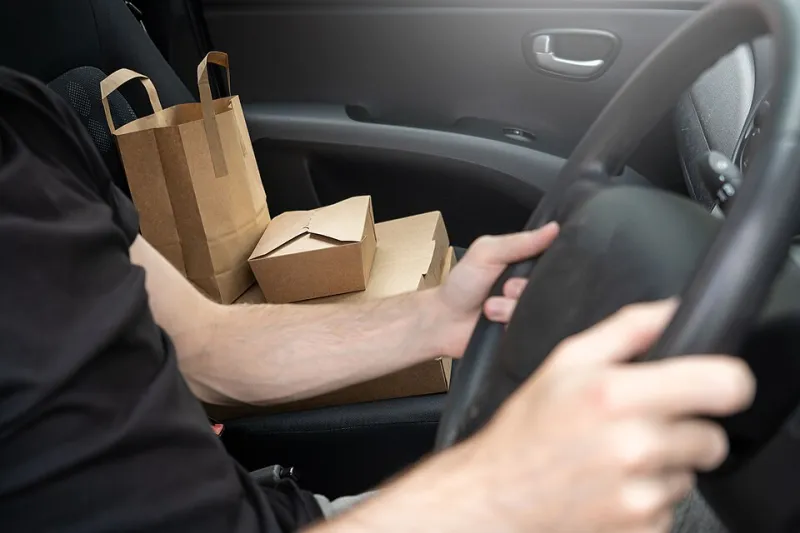
Photo: Meanwell Packaging, CC BY 2.0, via Wikimedia Commons
You're hungry. Or you need paper towels. Or maybe you just don't feel like leaving the couch. So you open an app, tap a few buttons, and forty minutes later someone's at your door. Convenient? Absolutely. Clean? Not even close.
The delivery economy — Uber Eats, DoorDash, Instacart, Amazon Flex, Grubhub, and the rest of the alphabet soup of on-demand platforms — has been sold to us as the future. Efficient. Tech-forward. Frictionless. But strip away the slick UX and the venture capital mythology, and what you've got is one of the most emissions-intensive, worker-exploiting, accountability-dodging business models in modern American commerce.
And the planet is footing the bill.
The Emissions Nobody's Counting
Here's the thing about gig economy platforms: they don't actually own the cars making your deliveries. They don't employ the drivers. In the eyes of these companies — and, thanks to some aggressive lobbying, in the eyes of the law — those drivers are independent contractors. Which means the carbon those vehicles pump into the air? Not the platform's problem.
It's a masterpiece of liability laundering.
According to a 2023 analysis by the Union of Concerned Scientists, food delivery trips in major U.S. cities generate significantly more emissions per meal than if a customer had driven to the restaurant themselves — largely because of the inefficiency of single-item, multi-stop routing. And unlike a restaurant that can measure its kitchen's gas usage or a retailer that tracks its supply chain, delivery platforms have no legal obligation to account for the tailpipe emissions of their contractor fleet.
The EPA's greenhouse gas reporting rules, designed for large facilities and manufacturers, were never built to capture this distributed, contractor-mediated model. So the emissions just... disappear from the ledger. Convenient, right?
Meanwhile, in cities like Los Angeles, Chicago, and New York, researchers have documented surges in traffic congestion tied directly to the proliferation of delivery vehicles circling blocks, double-parking, and making dozens of short trips that collectively choke urban air quality. A 2022 report from the NYC Department of Transportation found that app-based delivery vehicles were a growing contributor to midtown Manhattan's worsening gridlock — a gridlock that disproportionately affects low-income neighborhoods and communities of color who live closest to high-traffic corridors and suffer the worst respiratory health outcomes as a result.
Workers Carry the Weight — Literally
The emissions problem doesn't exist in isolation. It's baked into a labor model specifically designed to transfer costs — financial, physical, and environmental — onto workers.
Gig delivery workers typically use their own vehicles, pay their own gas, cover their own maintenance, and absorb the depreciation on cars that are being driven into the ground for poverty-level effective wages. Studies from the Economic Policy Institute and others have consistently shown that after factoring in vehicle costs, many gig workers earn below federal minimum wage. Some earn less than $5 an hour in net take-home pay.
These workers aren't choosing dirty cars because they love pollution. They're driving older, less fuel-efficient vehicles because that's what they can afford when platforms are skimming the margins and algorithmic tipping culture suppresses their income. The gig economy's carbon footprint is, in large part, a poverty footprint.
And who are these workers? Disproportionately immigrants, people of color, and working-class Americans with few other options. The same communities already bearing the brunt of environmental degradation are being recruited to drive it — one burrito delivery at a time.
What If They Actually Paid the Full Cost?
Let's do a thought experiment. What would happen if DoorDash or Uber Eats had to internalize the true environmental and social costs of their business model?
Imagine if platforms were required to:
- Report aggregate fleet emissions from contractor vehicles
- Pay into a congestion and air quality remediation fund for every delivery in urban zones
- Provide vehicle subsidies or EV transition support for workers
- Meet minimum effective wage standards that account for vehicle expenses
The delivery fee on your $14 burrito bowl would look a lot different. And that's exactly why these companies fight tooth and nail against any regulation that would make them responsible for what their model actually costs.
California's Proposition 22 — bankrolled by Uber, Lyft, DoorDash, and Instacart to the tune of over $200 million, making it the most expensive ballot initiative in state history — was specifically designed to lock in contractor status and prevent workers from accessing benefits that might force platforms to raise prices and compete on honest terms. It passed. The companies celebrated. Workers and the environment lost.
The 'Green' Pivot Is Mostly Theater
To their credit — or, more accurately, to their PR departments' credit — some of these platforms have made noise about sustainability. DoorDash has pledged to support electric vehicle adoption. Uber has made promises about an all-EV fleet by 2030. Amazon has ordered 100,000 electric delivery vans from Rivian.
But let's be clear about what these pledges actually are: long-dated, unenforceable commitments that don't address the structural problem. A DoorDash driver in Fresno isn't getting an EV subsidy anytime soon. The Amazon Rivian vans are for Amazon's own logistics network, not the independent contractors driving Amazon Flex packages in their personal Corollas. And Uber's 2030 EV pledge applies only in the U.S., Canada, and Europe — the markets where the regulatory pressure is greatest.
This is greenwashing with a side of geofencing.
What Needs to Happen
This isn't a problem you can recycle your way out of. The gig economy's environmental damage is structural, and it requires structural solutions.
First, platforms need to be classified as the transportation and logistics companies they actually are — not technology companies that happen to facilitate transportation. That reclassification would open the door to emissions accountability, labor protections, and meaningful regulatory oversight.
Second, cities need to act. London's congestion charge and New York's embryonic congestion pricing program (which has faced its own political battles) point toward a model where the external costs of urban vehicle traffic get priced in. Delivery platforms should face tiered fees based on vehicle emissions and trip density, with those revenues directed toward transit improvements and air quality programs in affected neighborhoods.
Third, we need federal greenhouse gas reporting standards that close the contractor loophole. If a company's business model generates emissions, those emissions need to be counted — full stop.
Every time you open one of these apps, a real person gets in a real car and burns real fuel. The planet doesn't care whether that driver is an employee or a contractor. The atmosphere doesn't read terms of service agreements. But the companies profiting from this system have spent billions of dollars making sure the law does — and making sure you never think too hard about the gap between the two.
It's time to close that gap.