The True Price Tag on That $12 Shirt: Fast Fashion Is a Disaster — and Someone Else Is Paying for It
Let's talk about that shirt. You know the one — you grabbed it on a lunch break, maybe because it was twelve bucks and you had a thing to go to that weekend. It looked fine. It probably fell apart by the fourth wash. You might have donated it, or maybe it went straight in the trash. Either way, you moved on.
But that shirt had a life before you, and it will have a life after you — and neither chapter is pretty.
Fast fashion is one of the most destructive industries on the planet, and it has perfected the art of making that destruction invisible to the people doing the buying. The environmental cost, the human cost, the climate cost — all of it gets externalized. Pushed downstream. Handed off to workers in Bangladesh, to rivers in Cambodia, to landfills in the Atacama Desert that are now visible from space. The industry keeps the profit. Somebody else keeps the poison.
That's not a market inefficiency. That's a choice. And it's a choice rooted in a very old, very ugly logic: that certain people and certain places can absorb harm so that others don't have to.
What "Affordable Fashion" Actually Costs
The global fashion industry produces somewhere between 80 and 100 billion garments every year. Roughly 85 percent of textiles end up in landfills or incinerators. The industry accounts for about 10 percent of global carbon emissions — more than international aviation and maritime shipping combined, according to figures from the United Nations Environment Programme.
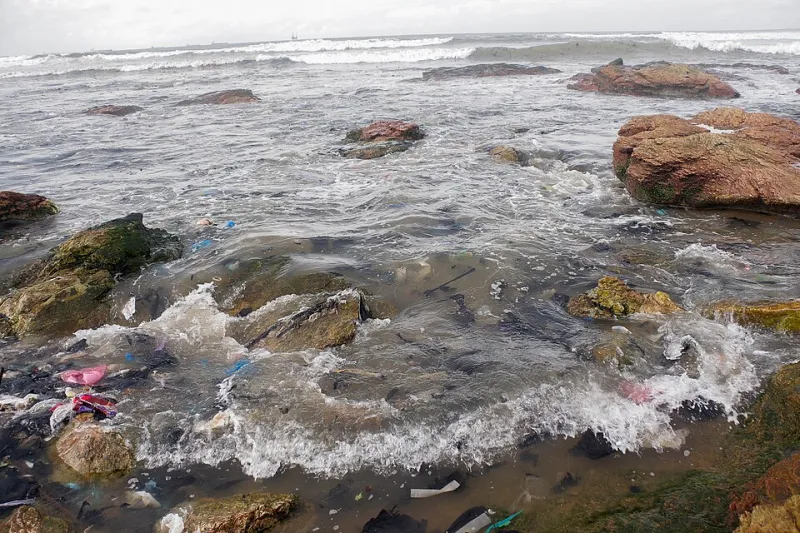
And that's before we get to the water. Textile dyeing is the second-largest polluter of clean water globally. The Citarum River in Indonesia, once a source of drinking water and fish for millions of people, is now so thick with industrial runoff — chromium, lead, arsenic, synthetic dyes — that it has been called one of the most polluted rivers on Earth. Similar stories play out in the Buriganga in Bangladesh, the Pearl River Delta in China, and dozens of other waterways that happen to run near the places where the world's clothes get made.
These aren't distant abstractions. They are the direct result of a supply chain optimized to move cost and consequence as far as possible from the consumer.
Environmental Racism Isn't Just an American Problem
In the U.S., we talk a lot about environmental racism — the well-documented pattern by which toxic facilities, polluting industries, and environmental hazards are disproportionately sited in Black, brown, and low-income communities. The principle applies globally, and the fast fashion supply chain is one of its clearest expressions.
The workers cutting, sewing, and finishing garments in factories across South and Southeast Asia are overwhelmingly women of color earning wages that keep them in poverty even as the brands they work for post record profits. When those factories discharge untreated wastewater into local rivers — which they do, constantly, because proper treatment is expensive and enforcement is weak — it's those same workers and their families who drink the water, bathe in it, and watch their children get sick.
The communities bearing this burden didn't choose it. They were chosen for it, by a global economic system that treats their lives as a line item to be minimized.
When Shein hauls in billions in revenue while the workers in its supply chain earn a few cents per garment, that's not just an inequality story. It's a climate justice story. It's a human rights story. And it's a story that every American consumer is participating in, whether we realize it or not.
The Greenwashing Won't Save Us
The industry knows the heat is rising — pun very much intended. Which is why the last several years have brought a flood of "sustainable collections," recycled-fiber lines, and carbon-neutral pledges from brands that have absolutely no intention of slowing down production.
H&M's Conscious Collection. Zara's Join Life label. These initiatives are real in the sense that the marketing budgets behind them are real. The actual environmental impact is a different story. A 2023 investigation by the Norwegian Consumer Authority found that Stormberg and H&M's sustainability claims were so vague and unsubstantiated that they violated consumer protection law. In the U.S., the FTC has updated its "Green Guides" to crack down on misleading environmental claims — but enforcement remains thin, and the greenwashing continues.
You cannot recycle your way out of overproduction. You cannot offset your way out of a business model built on making clothes so cheap and so disposable that wearing something twice feels like commitment.
What You Can Actually Do
Here's where a lot of these pieces pivot to a list of ethical brands, and honestly? That's part of the conversation. But let's be real with each other: individual consumer choices, while meaningful, are not going to restructure a global industry. We need both.
On the personal side: buy less. Full stop. Thrift when you can — thrift stores, clothing swaps, Buy Nothing groups, and secondhand apps like ThredUp and Poshmark divert real volume from landfills and reduce demand for new production. When you do buy new, look for certifications that actually mean something: GOTS (Global Organic Textile Standard) and Fair Trade USA are among the more rigorous. Avoid fast fashion brands entirely when possible — and yes, that includes the ultra-fast fashion platforms that have made H&M look restrained by comparison.
On the political side: push for corporate accountability. The FABRIC Act, introduced in Congress, would restore domestic garment manufacturing and strengthen wage protections for textile workers. Extended Producer Responsibility policies — which make brands financially responsible for the end-of-life disposal of their products — are gaining traction in Europe and deserve serious attention here. Contact your representatives. Support organizations doing supply chain accountability work, like the Clean Clothes Campaign and the Worker Rights Consortium.
And talk about this. The invisibility of fast fashion's harm is not an accident — it's engineered. Every time we name it, we chip away at the wall the industry has built between the $12 shirt and the river it poisoned.
The Planet Doesn't Have a Returns Policy
We are living through a moment when the consequences of decades of extraction and externalization are becoming impossible to ignore. Floods, fires, heat waves that kill — these are the receipts. And the communities that contributed least to this crisis are absorbing the worst of it, just as they absorbed the chemical runoff and the poverty wages that kept the price tags low.
Fast fashion is a microcosm of the larger story: an economic system that privatizes gain and socializes harm, that treats the Earth and the people most vulnerable to its destruction as acceptable losses.
We can see it clearly now. The only question is what we do about it.