Prime Deception: Amazon's Climate Pledge Is a PR Stunt While Its Delivery Empire Chokes the Planet
Amazon would love for you to picture a sleek electric delivery van rolling quietly down your street, a little blue lightning bolt on the side, zero tailpipe emissions, the future arriving at your doorstep. That's the image the company has spent hundreds of millions of dollars cultivating. Jeff Bezos — and now Andy Jassy — want you to associate that cardboard box on your porch with a cleaner tomorrow.
There's just one problem: it's a fantasy built on carefully selected metrics, strategic omissions, and the kind of corporate greenwashing that's become so polished it's almost art.
Amazon's real climate story isn't about electric vans. It's about an empire of concrete, diesel, and jet fuel expanding faster than any renewable energy commitment can keep pace with. And while the company markets itself as a leader in the fight against climate change, the data tells a very different story.
The Pledge That Launched a Thousand Press Releases
In 2019, Amazon co-founded the Climate Pledge, a high-profile commitment to reach net-zero carbon emissions by 2040 — ten years ahead of the Paris Agreement's 2050 target. The announcement made headlines. Environmentalists cautiously applauded. The PR machine roared to life.
Amazon ordered 100,000 electric delivery vehicles from Rivian. It announced investments in renewable energy. It published glossy sustainability reports. It encouraged other corporations to sign the pledge. It even named its Seattle arena after it.
But here's what didn't make the press releases: Amazon's own reported carbon emissions grew by more than 40 percent between 2019 — the year it launched the Climate Pledge — and 2021. That's not a typo. In the two years immediately following its landmark green announcement, the company's footprint exploded.
Amazon has since claimed emissions are leveling off. But leveling off a massively inflated number isn't progress. It's spin.
Warehouses: The Carbon Factories Nobody Talks About
When people think about Amazon's environmental impact, they tend to picture delivery trucks. But the real story starts long before a package hits the road.
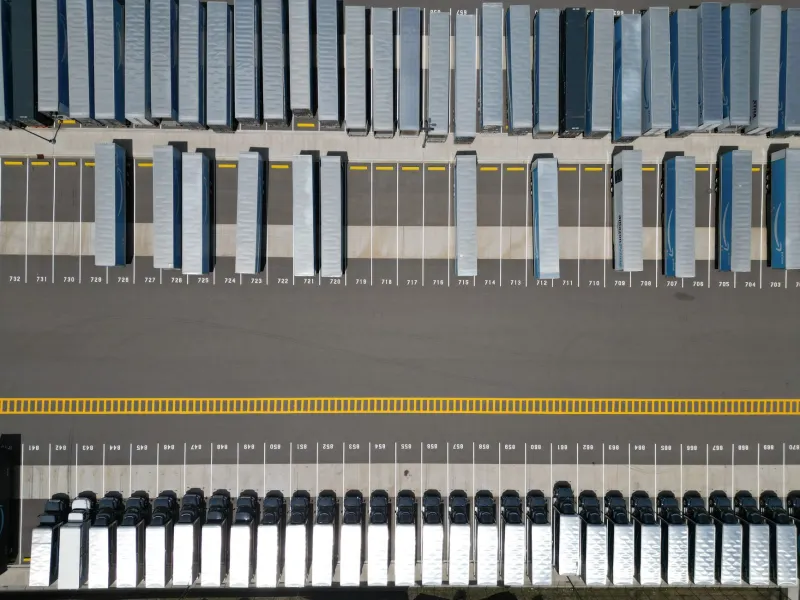
Amazon has been on a warehouse construction binge unlike anything the logistics industry has ever seen. Between 2020 and 2023, the company added tens of millions of square feet of fulfillment and distribution center space across the United States. These aren't small operations. We're talking about buildings the size of multiple city blocks, often built on previously undeveloped land, requiring massive amounts of steel, concrete, and energy to construct and operate.
The carbon cost of that construction — what's known as embodied carbon — is rarely factored into Amazon's public sustainability accounting. Neither is the land use change, the stormwater runoff, or the destruction of green space that comes with paving over fields and forests from New Jersey to the Central Valley.
And once those warehouses are running? They're energy hogs. Climate-controlled fulfillment centers run 24 hours a day, seven days a week. Yes, Amazon has invested in rooftop solar and renewable energy credits — but renewable energy credits are not the same as actually running on clean power. Buying a certificate that says clean energy exists somewhere on the grid is not equivalent to powering your operations with it.
Last-Mile Logistics and the Air Quality Crisis Hitting Your Neighborhood
Let's talk about what same-day delivery actually costs the people living near Amazon's distribution hubs.
The push for faster and faster shipping has forced Amazon to build smaller "last-mile" delivery stations deep inside urban and suburban communities — often in low-income neighborhoods and communities of color that already bear disproportionate pollution burdens. These facilities run fleets of diesel vans in and out at all hours, idling engines, generating particulate matter, and degrading local air quality in ways that don't show up in Amazon's sustainability reports.
Researchers and community advocates across the country — from Maspeth, Queens to Jurupa Valley, California — have documented the health impacts: increased asthma rates, elevated PM2.5 levels, chronic respiratory illness in children. Amazon's electric van fleet, while real, represents a small fraction of its total delivery vehicles. The vast majority of packages still move on diesel.
And it gets worse. A huge chunk of Amazon's logistics network relies on contracted third-party drivers — gig workers in their own personal vehicles — who aren't counted in Amazon's official emissions reporting at all. It's a convenient accounting trick: outsource the dirtiest part of your operation, then exclude it from your carbon math.
The Aviation Problem Amazon Doesn't Want to Discuss
Amazon Air. Two words that should make any serious climate advocate's blood pressure spike.
Amazon's private cargo airline has grown into one of the largest air freight operations in the country, with a fleet of over 100 aircraft and dedicated air hubs in cities like Cincinnati, Fort Worth, and Lakeland, Florida. Aviation is one of the most carbon-intensive forms of transportation on the planet — roughly 2 to 3 percent of global CO2 emissions, with additional warming effects from contrails and high-altitude emissions that make the real climate impact significantly worse.
There is no electric cargo jet. There is no credible near-term solution to decarbonizing aviation at scale. And yet Amazon keeps expanding its air network to feed the insatiable appetite for next-day and same-day delivery.
This is the fundamental contradiction at the heart of Amazon's climate pledge: the business model itself — built on speed, volume, and convenience — is structurally incompatible with meaningful emissions reduction. You cannot promise net-zero while simultaneously racing to deliver more packages faster than ever before.
Who Actually Pays the Price?
As usual, it's not the shareholders. It's not the executives with their stock options and private jets. It's the warehouse workers breathing recycled air in sweltering fulfillment centers. It's the kids in Riverside County with inhalers. It's the communities that never got a vote on whether they wanted a 24-hour diesel depot next to their elementary school.
It's also, increasingly, the rest of us — dealing with the downstream consequences of a climate crisis that Amazon's growth is actively accelerating, even as the company plasters its name on an arena and calls itself a planetary hero.
What Accountability Actually Looks Like
Here's what we should be demanding:
Full supply chain emissions disclosure. Amazon should be required to report Scope 3 emissions — including contracted delivery drivers, construction, and aviation — with the same rigor as its direct operations. No more convenient carve-outs.
Independent auditing. Corporate sustainability reports written by the corporations themselves aren't accountability. They're marketing. Third-party, government-verified emissions reporting should be mandatory for any company of Amazon's scale.
Community veto power. Neighborhoods should have meaningful say in whether Amazon logistics facilities get built in their backyards — not a rubber-stamp zoning process greased by economic development promises.
An end to same-day delivery subsidies. The true cost of same-day delivery — in emissions, in worker exploitation, in community health impacts — is not reflected in the price you pay at checkout. It's externalized onto the rest of us. That has to change.
Amazon built its empire on the promise of convenience. But convenience for whom? At what cost? And paid by whom?
The Climate Pledge is a good story. It's just not a true one. And until we hold companies like Amazon to account for the full scope of their impact — not just the parts they choose to highlight in their annual reports — we're going to keep getting sold a dream while the planet ships the nightmare.